
Compare the construction logic before requesting a sample
The choice between fully fashioned knitwear and cut-and-sew construction affects how a garment is shaped, joined, adjusted, finished, and reviewed. A clothing brand does not need to make this decision from a construction label alone. The useful starting point is the product brief: intended silhouette, stretch behavior, seam visibility, decoration, size range, and the level of shaping expected from the knitted panels.
Fully fashioned knitting forms shaping into the knitted components, while cut-and-sew knitwear typically uses knitted fabric that is cut into pattern pieces and assembled. The best route is project-dependent. A development partner can interpret the design, review the reference information, and identify which construction approach should be tested in the sample stage.
In the brief, record the garment category, target wearer, key measurements, desired ease, neckline and sleeve details, hem treatment, and any jacquard, intarsia, cable, rib, lace/openwork, embroidery, flocking, printing, appliqué, sequins, crochet, or hand-finished details. This gives the sample team a clear basis for comparing construction choices rather than evaluating appearance in isolation.
Map shape, stitch structure, and assembly requirements
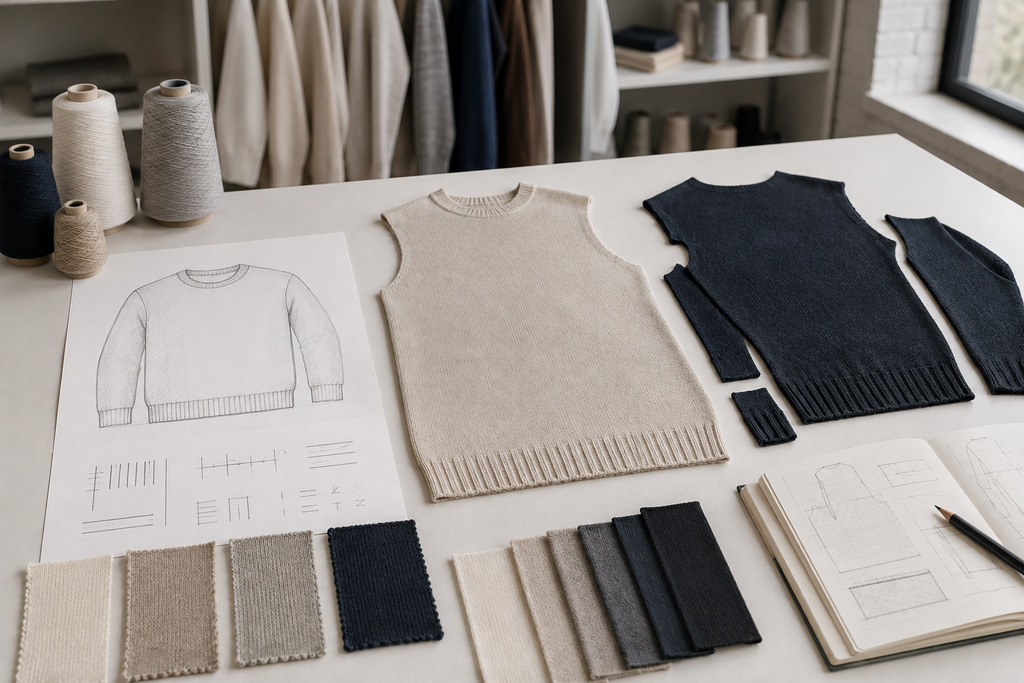
Once the design intent is clear, map which areas need knitted shaping and which areas need stable assembly. Shoulder slopes, armholes, sleeve caps, neck openings, side seams, hems, and cuffs should be described with enough detail for the team to review their relationship. Stitch selection also matters: rib knit, cable knit, lace/openwork, and plain structures can behave differently when they are shaped, linked, or cut and sewn.
The knitting program, yarn selection, and panel dimensions should be considered together. Computerized flat knitting can support detailed panel development, while linking and assembly determine how the components come together. For a cut-and-sew option, the brief should also identify the fabric direction, cutting considerations, seam allowances, and any points where pattern placement must be preserved.
A practical comparison asks: where should the garment carry shape, where should it allow movement, and where should the seam or join be visually quiet? These questions help a clothing brand compare prototypes on construction logic, not just on the first visual impression.
[IMAGE_2]
Review the representative sample for fit and comfort
The sample review should use a representative size and a written checklist. Check chest, body length, shoulder position, sleeve length, cuff recovery, neckline opening, hem behavior, and the appearance of joins. Try the garment through the intended movement range and note whether the construction supports the required comfort and silhouette.
Compare fully fashioned and cut-and-sew versions using the same design intent wherever possible. Look for differences in panel shape, seam bulk, edge stability, drape, and the way decoration aligns across joins. If a change is needed, record the exact area, the observed issue, and the requested adjustment. The development process can then move through fit adjustment and sample refinement with a shared reference.
For multi-size requirements, keep the grading discussion connected to construction. A shape that works in one representative size may need a different panel or pattern review across the size range. Final specifications should remain project-dependent until the sample and fit review establish the workable route.
[IMAGE_3]
Confirm finishing, inspection, and packing expectations
Before bulk production, review the finishing route for the selected construction. Confirm the expected garment appearance, loose-end management, seam or linking consistency, decoration placement, measurements, labeling requirements, and packaging instructions. The review should cover raw materials, knitted panels and assembly, finished garment appearance, and packaging/shipment readiness.
A knitwear OEM or ODM partner can coordinate design interpretation, yarn selection, knitting programming, sample development, fit adjustment, bulk production, finishing, quality inspection, and packaging. WTBF’s stated capabilities include a 10,000-square-meter production area, 100+ employees, 500+ computerized flat knitting machines, and 100+ linking machines. These figures describe available production resources; project-specific capacity, MOQ, lead time, and delivery details should be confirmed for the individual program.
The final brief should name the selected construction route, the points that remain to be confirmed, the sample approval criteria, and the quality checkpoints. This makes the handoff clearer for brands, retailers, and buying teams preparing a production order.
[IMAGE_4]
FAQ
What is the main difference between fully fashioned and cut-and-sew knitwear?
Fully fashioned knitwear shapes knitted components during knitting, while cut-and-sew knitwear generally cuts pieces from knitted fabric before assembly. The suitable choice depends on the design, materials, fit, and project requirements.
Which construction method is better for a sweater?
Neither method is universally better. Compare the intended silhouette, seam effect, stretch, decoration, size range, and finishing requirements during sample development.
Can the same knitwear design be tested with both methods?
In some projects, yes. The brief should define the shared design intent and identify which construction variables will be compared so the review remains useful.
Are MOQ and lead time fixed for fully fashioned knitwear?
They are project-dependent and should be confirmed with the manufacturing partner after the design, yarn, construction, sample, and production requirements are reviewed.
Need help with your knitwear construction brief?
Share your design brief, reference sample, target measurements, yarn preferences, and decoration requirements with Wait To Butterfly for a project-based review.
Website: https://waittobutterfly.com/
WhatsApp: +1 (669) 358-6009
Email: xyzzzlife@gmail.com